
"A town with only a switch and a warehouse."
The founding of Newburg, Iowa

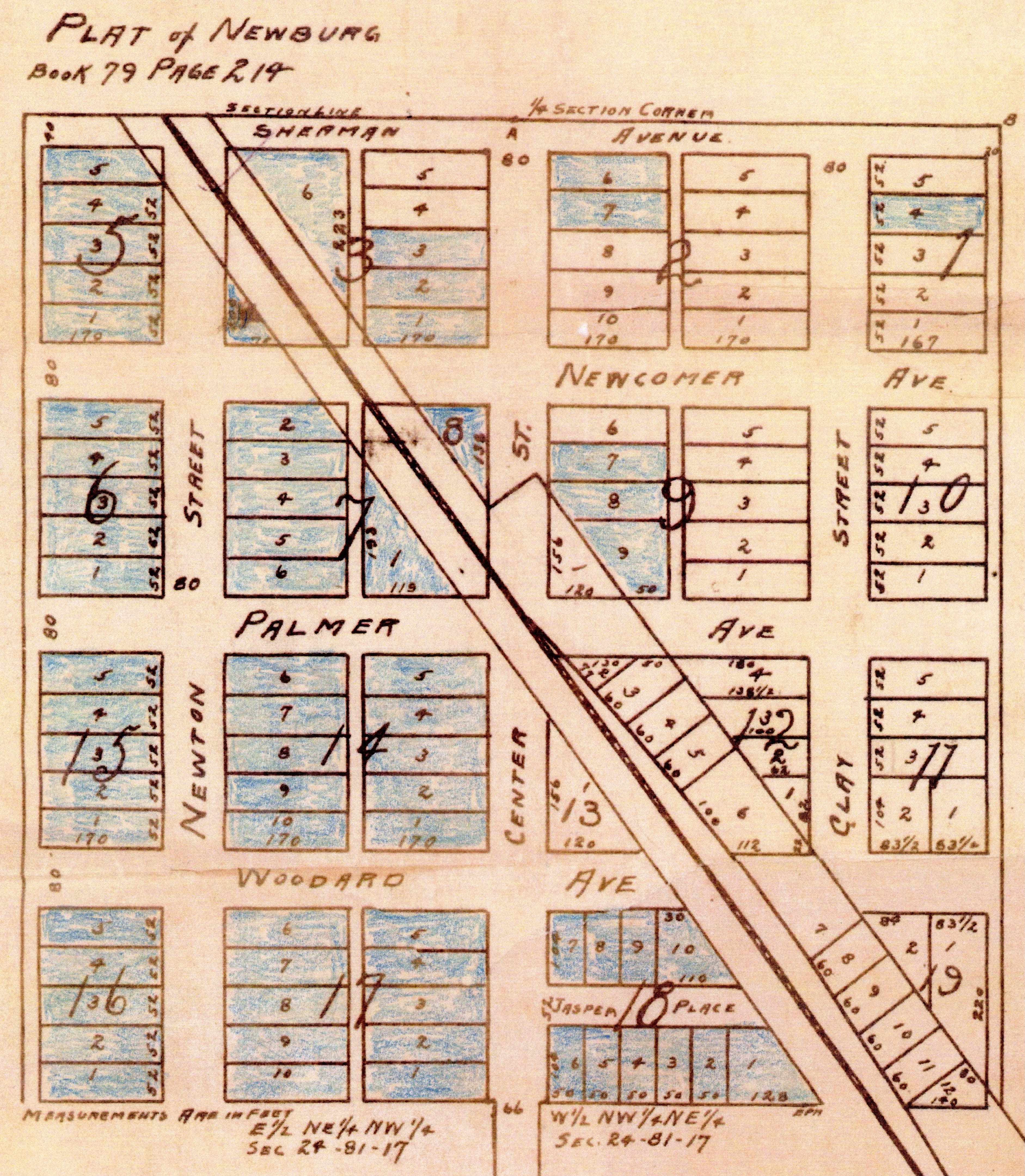
In August 1878, Eugene Taylor lost a case of drawing instruments on the road between Grinnell and Gilman. A notice appeared in the 20 August issue of the Grinnell Herald offering a “liberal reward” for “leaving it at Morse & Whitney’s or the Herald office.”1 Eugene Taylor would one day become a noted architect, but in August 1878, he was a recent graduate of Grinnell College returned home after two years of studying architecture at MIT.2 Taylor’s sister, Jane, was married to Gus Whitney.3 Gus Whitney was the junior partner in the Morse & Whitney grain firm in Grinnell,4 which had already established a grain-buying station at Ewart5 and was in the process of leasing an elevator at Searsboro.6 Morse & Whitney had another project in the works. Eugene Taylor was carrying his case of drawing instruments on the road between Grinnell and Gilman because he was surveying the plat for a new village called Newburg.
Taylor’s survey was “fixed upon the old Government Corner which was plainly visible at the time of the survey”.7 The corner was “marked by a piece of railroad rail placed upright in the ground with a granite boulder on top.” That point was marked “A” on the plat. Following the earlier surveyor’s method, he also marked corners “B” and “C” on the plat “by pieces of railroad rails placed upright in [the] ground”. Surveying the plat was not to be Taylor’s last job at Newburg. Eugene Taylor was about to become Newburg’s first inhabitant.8
An article in the same issue of the Herald that offered a reward for the return of Eugene Taylor’s drawing instruments gave the first public details of Newburg:
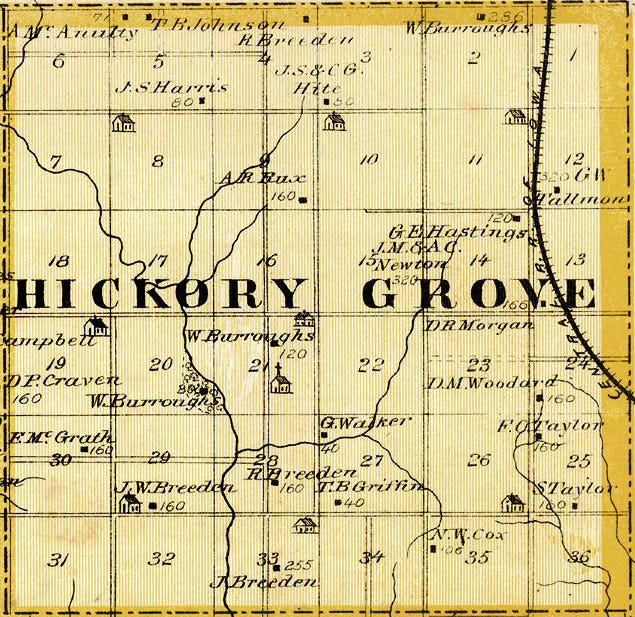
“A new station is being built on the Central about six and a half miles north of this place in Hickory Grove Township. It is located on the northwest quarter of section 24, just east of D. R. Morgan’s place. The new station is to be called Newberg, and application has been made to have a postoffice established there. Morse & Whitney are putting up a warehouse, and parties are already looking over the ground as to the advisability of erecting a store. Eugene Taylor will represent Morse & Whitney in the grain trade at the new station and probably will occupy the position of Nasby also.”9
One imagines Eugene Taylor surveying the plat of Newburg alone on the open prairie. But Dwight Morgan’s house was just across the road to the north and had been since 1866.10 The Morgans might have watched Taylor work. Lucy Morgan’s obituary says, “They saw the bare, fenceless prairies develop into a prosperous, progressive community.”11 The railroad, too, was already there and had been running diagonally through the center of what was to become Newburg since February 1871.12 The Central Railroad of Iowa train ran north through Grinnell at 3:25 p.m. and 2:30 a.m. every day, and it ran south through town at 12:55 p.m. and 7:12 pm.13 Six miles north of Grinnell, the passengers might have waved to the surveyor working beside the tracks.
Ten days after the first article appeared, the Herald reported that Morse & Whitney were already in business:
“Morse & Whitney began the grain trade at the new town of Newberg yesterday morning and Mr. Whitney informs us that this evening they shall ship eight car loads. Pretty well for the first two days trade in a town with only a switch and a warehouse.”14
Events on the ground in Hickory Grove Township were running ahead of the legal process at the Jasper County Courthouse in Newton. Horace Palmer, of Northfield, Summit County, Ohio, had purchased the north half of Section 24 in Hickory Grove Township on 01 December 1855.15 But on 01 April 1878, Horace Palmer and his wife, Margaret, still in Northfield, had mortgaged the northwest quarter-section to Ralph H. Hall, a banker from Chautauqua County, New York.16 Before Morse & Whitney could officially invest in the twenty acres on which the west half of Newburg was to sit, the Palmers had to get the land released from the mortgage. This was accomplished on 19 August 1878 when Ralph H. Hall released the twenty acres from the mortgage “with the distinct understanding that the remaining one hundred and forty acres described in said Mortgage is held on security for the full payment of the Note.”17 On the same day the land was freed from encumbrance, the Palmers sold 2.75 acres, marked on the plat as “Rail Road Grounds”, to the Central Railroad of Iowa “in consideration of the sum of One Dollar and the location of a Station” on the site.18 The station, of course, was needed to ship the grain. Without the station, there was no Newburg.
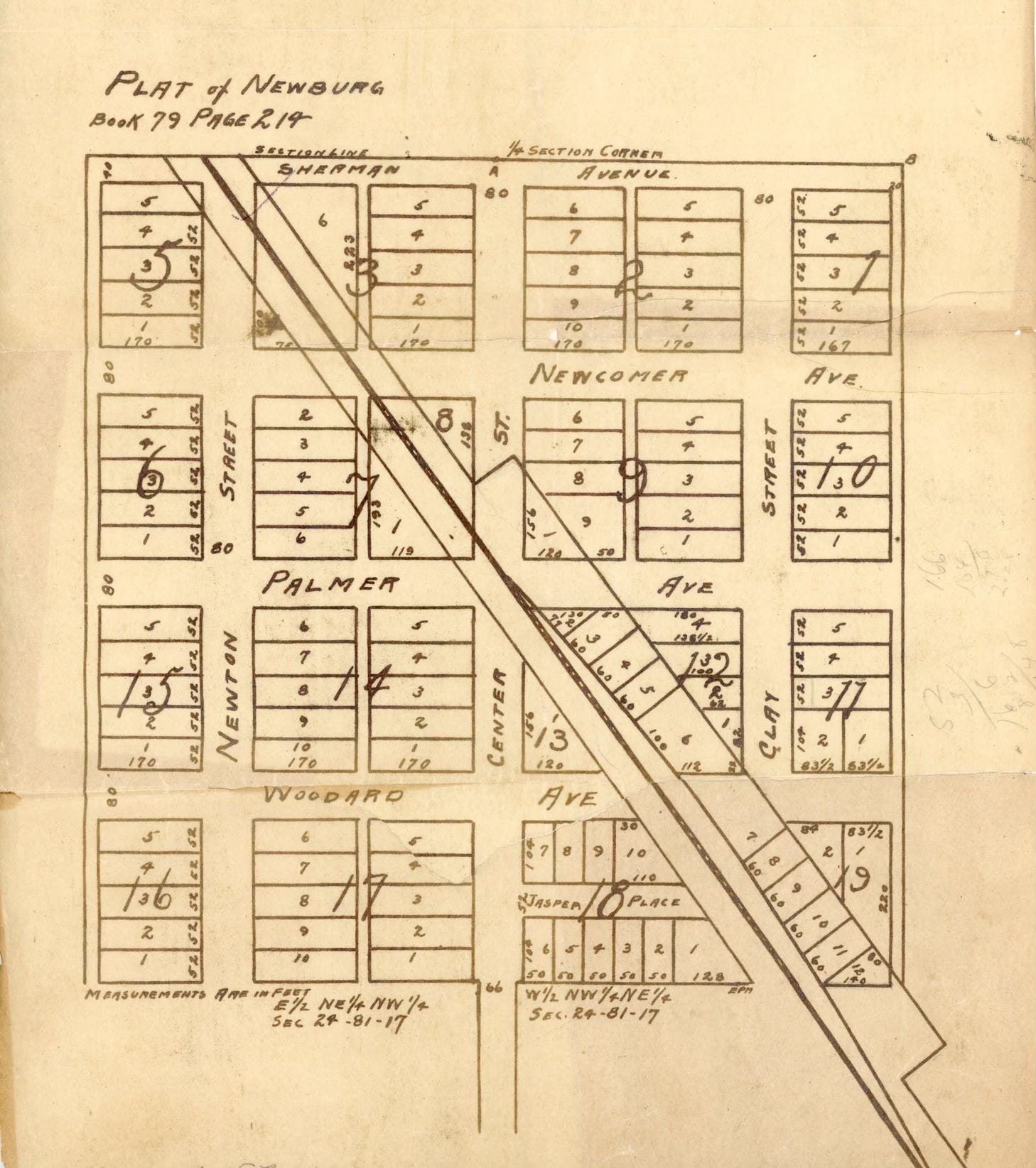
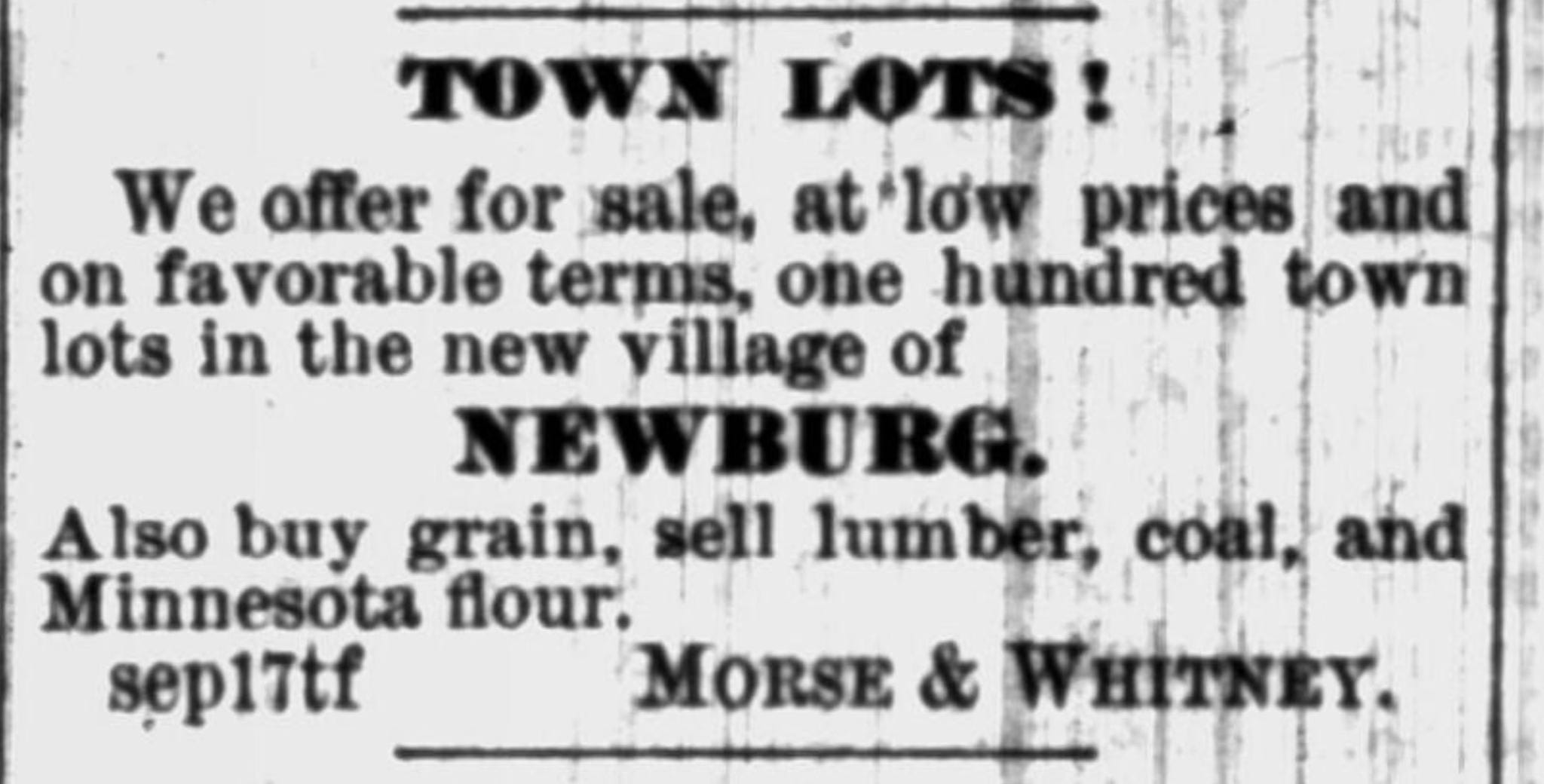
On 17 September 1878, the first advertisement appeared in the Grinnell Herald offering “for sale, at low prices and on favorable terms, one hundred town lots in the new village of Newburg.”19 Two days later, on 19 September 1878, 21 days after Morse & Whitney started buying and shipping grain at Newburg, three documents were signed. The first document, signed by Horace and Margaret Palmer in front of a Notary Public in Summit County, Ohio, approved the plat of Newburg as surveyed by Eugene Taylor.20 With the same document, the Palmers dedicated “to the public for a Highway” a strip of land running 80 rods south from Newburg, essentially an extension of Center Street as marked on the plat.21 With the second document, for $1,000, Charles Morse and Gustavus Whitney purchased a half interest in all the lots of Newburg except Lots 1 and 2 of Block 12 which they bought in full.22 With the final document signed on 19 September 1878, Morse & Whitney and the Palmers appointed Robert M. Haines23 of Grinnell their power of attorney to “convey with covenants of warranty any and all lots owned by us in the village plat of Newburg . . . as fully and completely as we might or could if personally present.”24 He was also authorized to “cancel any and all Mortgages running to us or any of us which may be given for the purchase price of any of the said lots.” The wording of that clause seems important since Morse & Whitney did offer mortgages on the Newburg lots while the Palmers did not.
The Grinnell Herald reported on 11 October 1878 that the Newburg post office was “now open and in running order”.25 As expected, Eugene Taylor was appointed Newburg’s first Postmaster. Four days later, in answer to a question about Newburg, the Herald said:
“It has a station, grain warehouse, and post-office, and, it is to be presumed, a residence or two and perhaps a store. It was started only a couple of months ago but as it has the lively firm of Morse & Whitney of this place to back it there is no telling how immense a future lies before it.”26
Most likely, neither store nor residence had yet been built in Newburg (although Eugene Taylor had to be sleeping somewhere). The first lot sold in Newburg, Lot 4 of Block 12, was purchased by Julius Richardson on 04 December 1878. He paid $50 for the lot, and the transaction was brokered by the attorney Robert M. Haines.27 When Richardson passed through Grinnell in 1891, the Herald referred to him as “the first storekeeper of Newburg.”28 On 23 December 1878, John Adam Rosebach purchased Lot 2 Block 10 and Lot 4 Block 12.29 He, too, was a storekeeper.30 Haines brokered that sale as well. Including the two lots purchased in full by Morse & Whitney, by the end of 1879, 14 of the 105 lots in Newburg had sold. Of those lots, six were mortgaged to Morse & Whitney at 10% interest in 1880.31
In September 1879, approaching the first anniversary of its founding, the Grinnell Herald “took a ride to the thriving young town of Newburg”. It reported:
“This place was laid out about one year ago, by Messrs. Morse & Whitney, of this city, and today has two large grain houses, by the above firm, a post office, express office and a lumber yard, which are also in charge of Morse & Whitney. Mr. J. A. Rosenbach has a large store building, and carries a large stock of Dry Goods, Groceries, Queensware, Glassware, Tinware and Grocers Hardware, Boots, Shoes, Hats and Caps. . . . Mr. F. M. Risse has a large blacksmith and wagon shop, and being an excellent workman is doing well. He has also erected a two story dwelling. . . . Next we find Mr. Fay, who has erected a store building, with a dwelling apartment on second floor, and put therein a nice stock of Groceries, Boots, Shoes and Queensware. . . . There is also being erected a good sized house of worship, by the members of the Church of God. . . . There is a prospect of some other buildings being put up in the near future.”32
Ed Fay purchased Lot 3 Block 12 on 30 April 1879.33 F. M. Risse didn’t purchase his Lots 3 and 4 of Block 9 until 11 December 1879.34 John Newcomer purchased Lot 5 of Block 2 for $1 on 13 August 187935 and gave it to the Trustees of the Church of God with the understanding they would build a church on the site.36
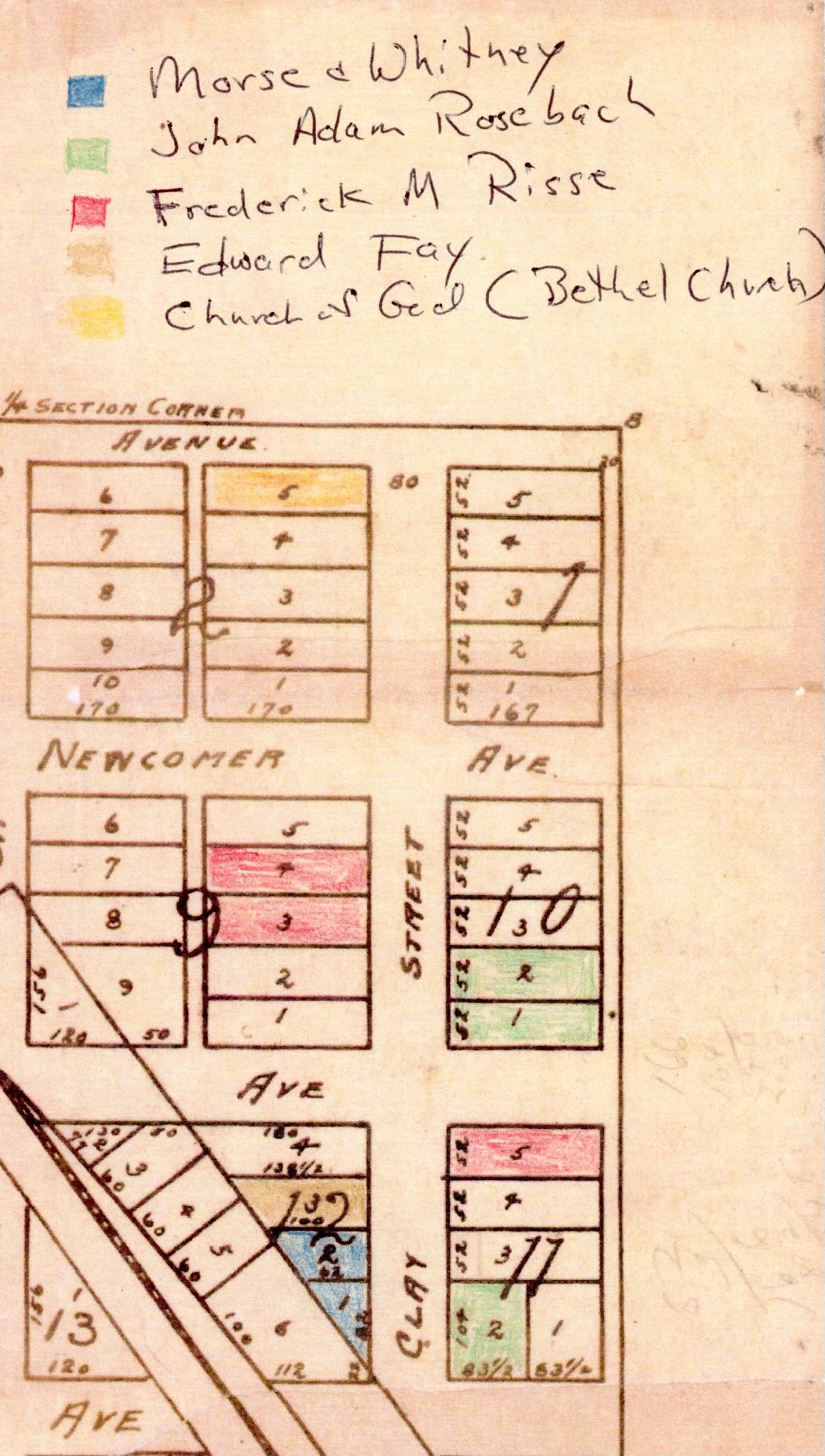
Curiously, no store is mentioned on Lot 4 of Block 12. That was the first lot sold in Newburg, and the Herald later referred to Julius Richardson, the purchaser, as Newburg’s first storekeeper. But since he was listed as a resident of Dallas County, Iowa when he sold the lot to Grinnell lumber and farm implement dealer Carhart & Sons in October 1879,37 perhaps Richardson had already left town.
In April 1880, Horace Palmer came to Hickory Grove Township to visit his son, Anson, who lived south of Newburg and farmed the Palmer land. While visiting his son, Horace Palmer contracted typhoid fever and died that August.38 Having never lived at Newburg, he died there. In his will, he left his half interest in the unsold lots of Newburg to his wife, Margaret.39 Gus Whitney sold his interest in the Morse & Whitney grain firm to his partner in November 188140 and the following December sold his quarter interest in the unsold lots of Newburg to Charles Morse for $1,500.41 Whitney then moved back to Waterloo where he had lived before coming to Grinnell.42 Charles Morse, in turn, sold his now half interest in the unsold lots for $1,500 to Nathaniel W. Cox and John Planalp in March 1882.43 Morse lived the rest of his life in Grinnell where he was a prominent businessman who served a term as mayor and, for many years, was president of the Merchants National Bank.44 Margaret Palmer accompanied her husband from Northfield, Ohio to Hickory Grove in 1880,45 and, after his death, she stayed, living south of Newburg with her son, Henry,46 before moving to Grinnell47 and then, in 1901, to Boise, Idaho.48 In 1892, Margaret Palmer sold her half interest in the unsold Newburg lots to her stepson, Anson, for $500.49 Anson Palmer then purchased the other half interest in those lots from Nathaniel W. Cox and Calvin Dickson (who had purchased John Planalp’s share50), also for $500, in 1894.51 Of the lots purchased by Anson Palmer, 11 lay northeast of the railroad tracks and 57 lay southwest of the railroad tracks. Most of the area of the Newburg plat southwest of the tracks was never developed and eventually was folded back into farm ground.
If you grow up in the Newburg area, your idea of the founding of a town is likely based on the story of J. B. Grinnell following the apocryphal advice of Horace Greeley to “Go west, young man”, on Grinnell’s noble mission to bring religion and education to the prairie. Newburg didn’t have a J. B. Grinnell. It seems to have been born of a business venture, a child of absentee founding fathers. Morse & Whitney wanted to buy and ship grain. The Palmers were willing to sell land on the railroad. None of them ever lived in Newburg, and when they sold their interests in Newburg, no newspaper reported it. None of their obituaries mention they had a role in the founding of a town in Hickory Grove Township. But a community did grow at Newburg. Creating that community seems to have been left to the people who moved there, and to the farm families who lived nearby.
“Local Notices”, Grinnell Herald, 20 August 1878, p. 3.
“College News”, Grinnell Herald, 11 June 1878, p. 3. More properly for the period, Taylor graduated from Iowa College, later called Grinnell College, and attended the Boston Polytechnic School, which morphed into the Massachusetts Institute of Technology.
“Local Matters”, Grinnell Herald, 09 December 1881, p. 3.
Waterloo Courier, 15 August 1872, p. 3.
“Local Matters”, Grinnell Herald, 13 January 1876, p. 3.
“Searsboro”, Grinnell Herald, 03 September 1878, p. 3.
Jasper County Iowa Recorder. General Book 79, p. 214.
Pinder, Dorothy. In Old Grinnell. Herald-Register Publishing Company. Grinnell, Iowa. 1995. P. 58.
“Local Matters”, Grinnell Herald, 20 August 1878, p. 3. “Nasby” was a colloquial term for postmaster.
“Dwight R. Morgan”, 26 September 1905, Obituary Database, Drake Community Library, Grinnell, Iowa {www.grinnell.lib.ia.us/Obit/M2/MorganDwight.pdf}.
“Mrs. Lucy Morgan Passes”, 18 December 1928, Obituary Database, Drake Community Library, Grinnell, Iowa {www.grinnell.lib.ia.us/Obit/M2/MorganLucy.pdf}.
“The Last Rail Laid”, Poweshiek County Herald, Grinnell, Iowa, 08 February 1871, p. 3.
“Railways”, Grinnell Herald, 20 August 1878, p. 3.
Grinnell Herald, 30 August 1878, p. 3.
Jasper County Iowa Recorder. General Book 43, p. 333.
Jasper County Iowa Recorder. General Book 92, p. 483.
Jasper County Iowa Recorder. General Book 93, p. 592.
Jasper County Iowa Recorder. General Book 99, p. 439.
“Town Lots!”, Grinnell Herald, 17 September 1878, p. 3. Curiously, there were 105 lots in Newburg.
Jasper County Iowa Recorder. General Book 79, pp. 214-5.
Ibid. p. 215.
Ibid. p. 216-217.
Robert M. Haines (1838-1902) was elected to the Iowa Senate in 1879 and was president of the Iowa State Bar Association at the time of his death. For his obituary, see “Robert M. Haines”, Grinnell Herald, 26 December 1902, p. 4.
Jasper County Iowa Recorder. General Book 93, pp. 593-4
“Local Matters”, Grinnell Herald, 11 October 1878, p. 3.
Grinnell Herald, 15 October 1878, p. 3.
Jasper County Iowa Recorder. General Book 79, p. 232.
Grinnell Herald, 12 June 1891, p. 3.
Jasper County Iowa Recorder. General Book 79, pp. 323-5.
“Newburg”, Grinnell Herald, 04 September 1879, p. 3.
For instance, F.M. Risse’s Lots 3 and 4 of Block 9: Jasper County Iowa Recorder, General Book 91, p. 189.
“Newburg”, Grinnell Herald, 04 September 1879, p. 3.
Jasper County Iowa Recorder. General Book 79, p. 263.
Ibid. p. 319.
Ibid. p. 287.
Ibid. p. 295.
Ibid. p. 300.
From an unattributed obituary found in the Edith Palmer Sears papers and posted to Find a Grave {www.findagrave.com/memorial/106476452/horace-hayden-palmer}.
Iowa, U.S., Wills and Probate Records, 1758-1997. Ancestry.com {www.ancestry.com/imageviewer/collections/9064/images/007592810_00206?pId=1098300}.
“Local Matters”, Grinnell Herald, 18 November 1881, p. 3.
Jasper County Iowa Recorder. General Book 79, p. 472.
Grinnell Herald, 31 January 1882, p. 3.
Jasper County Iowa Recorder. General Book 118, p. 112.
“Charles R. Morse”, Grinnell Herald, 14 April 1905, p. 4.
1880 United States Federal Census. Ancestry.com {www.ancestry.com/imageviewer/collections/6742/images/4240692-00317?pId=23449602}.
Iowa, U.S., State Census Collection, 1836-1925. Ancestry.com {www.ancestry.com/imageviewer/collections/1084/images/IA1885_207-0305?pId=5798144}.
Iowa, U.S., State Census, 1895. Ancestry.com {www.ancestry.com/discoveryui-content/view/1482709:7321?ssrc=pt&tid=192948457&pid=312512460224}.
“Land Sales”, Idaho Statesman, Boise, Idaho, 14 July 1901, p. 3.
Jasper County Iowa Recorder. General Book 178, p. 321.
Jasper County Iowa Recorder. General Book 79, p. 575.
Jasper County Iowa Recorder. General Book 196, p. 147.